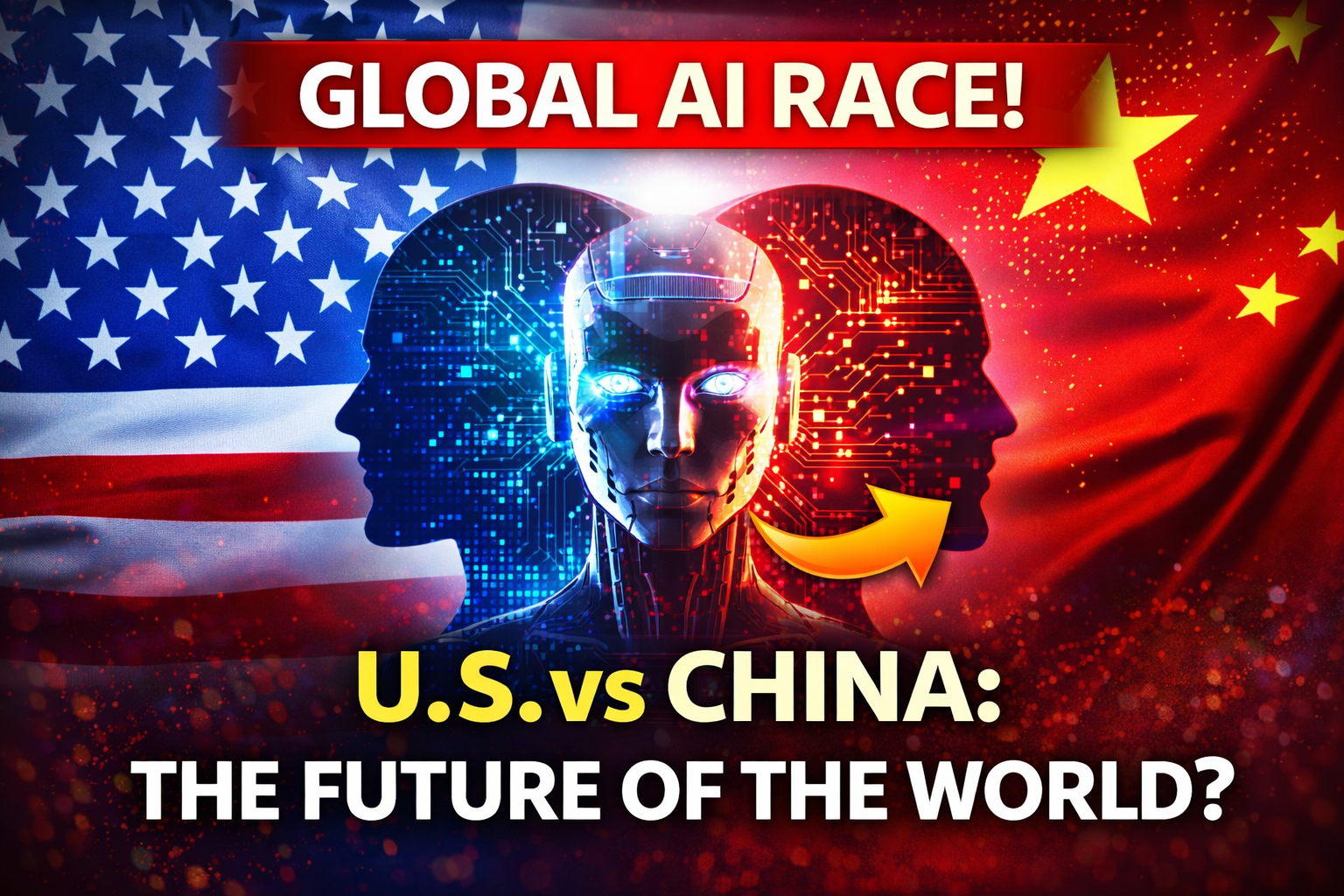
U.S. vs China AI Race: The Battle That Will Shape the Future
The global race to dominate artificial intelligence is intensifying between the U.S. vs China AI , and the outcome could reshape technology, economies, and global influence for decades. Governments, tech giants, and researchers are investing billions into AI development, from advanced chips and robotics to powerful generative models. Experts warn that whichever country leads this race may gain massive economic advantages and strategic power in the digital age. As innovation accelerates, questions about regulation, security, and the future of jobs are becoming more urgent. Here’s how the U.S.–China AI competition is evolving and why the world is watching closely.
News Desk global 2026
U.S. vs China AI Race That Could Define the Future of the World
Artificial intelligence is no longer just a technological trend—it has become a defining force shaping global power. Around the world, governments and technology companies are investing unprecedented resources into AI research, infrastructure, and talent.
At the center of this competition are two superpowers: United States and China. Analysts believe the nation that leads the AI revolution could influence global economics, military capability, and technological innovation for decades.
For policymakers, business leaders, and everyday citizens, this race is about far more than technology—it is about the future balance of power.
Why U.S. vs China AI Has Become So Important
Artificial intelligence is rapidly transforming industries across the world. From healthcare diagnostics to financial systems and transportation networks, AI is changing how societies function.
Experts believe AI could add trillions of dollars to the global economy over the next decade. Businesses are using AI to automate tasks, analyze massive datasets, and make faster decisions.
Because of this potential, nations see AI leadership as a strategic priority similar to the space race or U.S. vs China AI of the 20th century.
The United States: Innovation Powerhouse
The United States has long been a global center for technology innovation. Many of the world’s leading AI companies operate there, supported by strong research universities and investment networks.
Organizations like OpenAI, Google, and Microsoft are pushing the boundaries of machine learning and generative AI.
Silicon Valley continues to attract global talent and venture capital, helping the country maintain a strong lead in software innovation.
Government initiatives are also supporting research into advanced computing, cybersecurity, and AI regulation.
China’s Rapid Rise in AI
Over the past decade, China has dramatically expanded its artificial intelligence ecosystem. The country has invested heavily in data infrastructure, research institutes, and technology companies.
Major Chinese tech firms like Baidu, Alibaba, and Tencent are developing AI tools used by millions of people.
China’s large population and digital platforms generate vast datasets that can be used to train advanced AI systems.
The government has also announced ambitious plans to become a global AI leader within the next decade.
U.S. vs China AI Technology That Is Driving the Competition
Several technologies are at the center of the AI rivalry:
Advanced Chips
AI requires powerful processors capable of handling enormous computational workloads.
Large Language Models
These systems power chatbots, digital assistants, and automation tools used in businesses and governments.
Autonomous Systems
Self-driving vehicles, drones, and robotics are becoming major areas of innovation.
AI in National Security
Governments are exploring how AI can improve intelligence, cybersecurity, and defense capabilities.
Because these technologies can influence both economic and military power, the stakes are extremely high.
Economic Impact of the U.S. vs China AI Race
Artificial intelligence is expected to become one of the largest drivers of economic growth in the coming decades.
Companies using AI can:
-
Increase productivity
-
Reduce costs
-
Predict market trends
-
Automate complex processes
Countries that dominate AI development may gain advantages in global trade, finance, and manufacturing.
This is why policymakers see AI as a national priority rather than just a business trend.
Concerns About Ethics and Safety of U.S. vs China AI
Despite the excitement around AI innovation, experts warn about potential risks.
Some major concerns include:
-
Data privacy
-
Algorithm bias
-
Deepfake misinformation
-
Job displacement
-
Autonomous weapons
Global organizations are discussing regulations to ensure AI development remains safe and responsible.
Balancing innovation with safety will be one of the biggest challenges of the coming decade.
Could Other Countries Join the U.S. vs China AI Race?
Although the United States and China dominate headlines, other countries are investing heavily in AI as well.
Regions such as Europe, India, and parts of Asia are building research hubs and startup ecosystems focused on artificial intelligence.
The global AI landscape could become more competitive as new players emerge.
However, the scale of investment from the United States and China still puts them at the center of the competition.
The Future of the AI Superpower Race
The outcome of this technological rivalry U.S. vs China AI could influence global leadership for generations.
If one country achieves a major breakthrough—such as advanced general intelligence or revolutionary automation—it could reshape industries and geopolitics.
For now, the world is watching closely as innovation accelerates.
Artificial intelligence is no longer just a tool.
It is becoming the foundation of the next global era.
FAQs
1. Why is the AI race between the U.S. and China important?
Because AI technology could influence economic growth, security, and global leadership.
2. Which country currently leads in AI?
The United States leads in many areas, but China is rapidly catching up.
3. How will AI affect jobs?
Some jobs may be automated, but new careers in technology and data are also emerging.
4. Can other countries compete in AI?
Yes, many nations are investing heavily in AI research and development.
5. Is AI dangerous?
AI has risks, but responsible development and regulation can help reduce them.
next – America
Artificial Intelligence Is Reshaping American Jobs Faster Than Policymakers Can Respond