Artificial Intelligence Expansion Raises New Questions About U.S. Jobs and Regulation
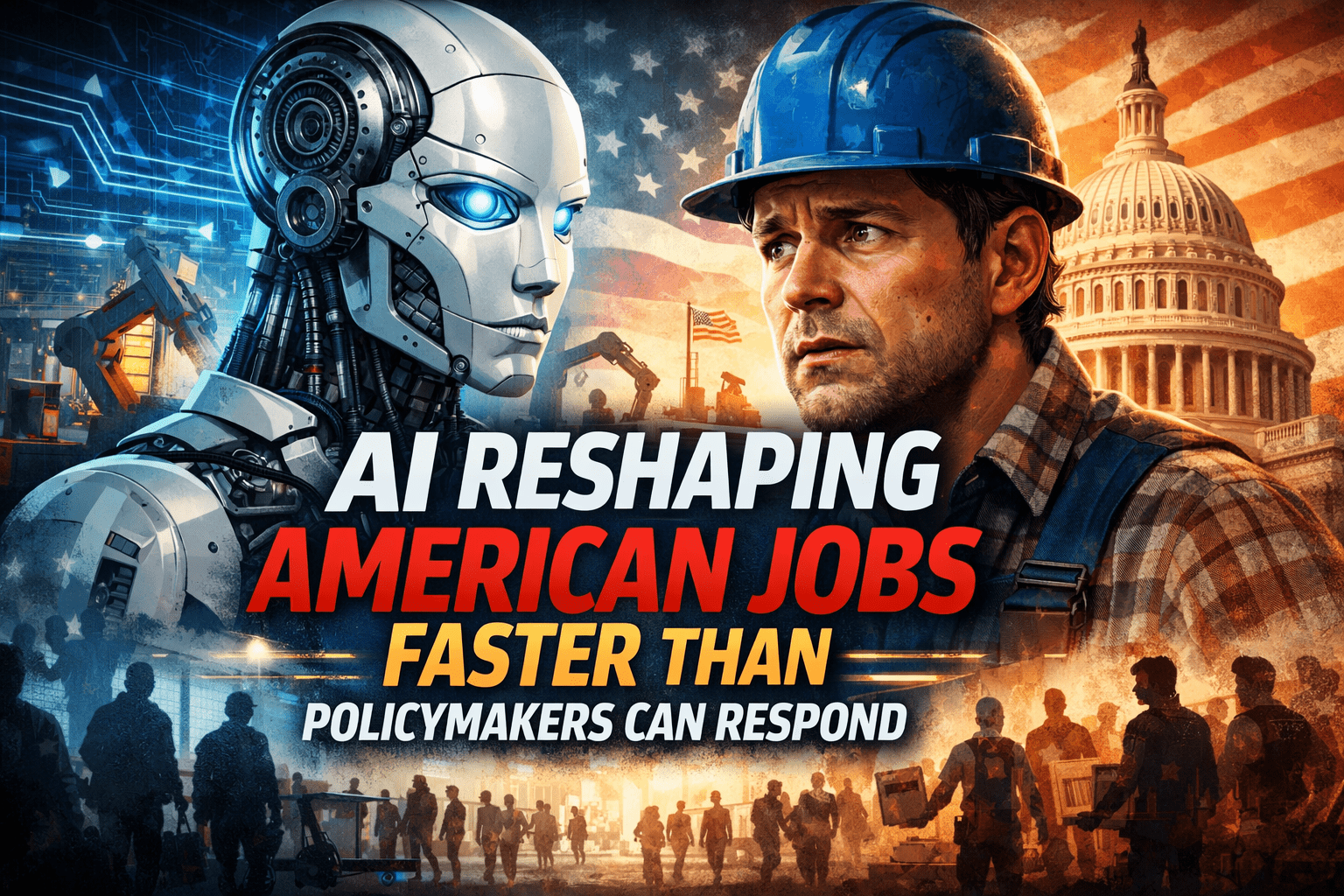
Artificial intelligence is rapidly transforming the U.S. economy, altering how Americans work, how businesses operate, and how the federal government approaches regulation — often faster than laws and institutions can adapt.Once limited to experimental use, AI tools are now embedded across industries including finance, healthcare, logistics, education, and government services. Economists and labor analysts say the pace of adoption marks a turning point that could redefine the American workforce over the next decade.
America360 News — February 2026
Businesses Accelerate AI Adoption Across Industries
U.S. companies are increasingly deploying artificial intelligence to automate tasks, reduce costs, and improve efficiency. From customer support chat systems to advanced data analysis tools, AI is now a standard part of business operations rather than a niche innovation.
Industry analysts note that companies failing to adopt AI-driven systems risk losing competitiveness, particularly as global rivals move aggressively into automation and machine learning.
Small and mid-sized businesses face unique challenges, balancing the benefits of AI against rising implementation costs and workforce disruption.
Job Losses and Job Creation Occur Simultaneously
Labor experts say AI is already displacing certain roles, particularly in routine administrative work, customer service, and basic content production. At the same time, demand is rising for workers skilled in data analysis, cybersecurity, AI system management, and software engineering.
This uneven shift has raised concerns about a growing skills gap, with workers lacking access to retraining programs facing increased economic uncertainty.
Federal labor data suggests automation-related job changes are accelerating, though comprehensive long-term employment impacts remain under study.
AI Emerges as a National Security Priority

Beyond the economy, artificial intelligence has become a strategic focus for U.S. national security planners. Defense and intelligence agencies are investing in AI for data processing, threat detection, and operational planning.
Officials have warned that foreign governments are advancing AI capabilities at a rapid pace, increasing pressure on the United States to maintain technological leadership while protecting sensitive data and infrastructure.
At the same time, experts caution that widespread AI use raises ethical and security concerns, including algorithmic bias, surveillance risks, and the spread of AI-generated misinformation.
Lawmakers Struggle to Keep Pace With Technology
Despite bipartisan recognition of AI’s importance, federal regulation remains limited. Lawmakers continue to debate how to balance innovation with oversight, as concerns grow over privacy, transparency, and worker protections.
Several states have introduced their own AI-related policies, creating a fragmented regulatory landscape that businesses and consumers must navigate.
Policy analysts say clearer national standards could provide stability, but agreement on enforcement and scope remains elusive.
A Defining Moment for the American Workforce
Economists say the speed and scale of AI( Artificial intelligence ) adoption distinguish it from previous technological shifts. Unlike past automation waves that primarily affected physical labor, AI is reshaping cognitive and professional roles once considered resistant to automation.
Education systems, workforce training programs, and employers are now under pressure to adapt quickly to prevent long-term displacement and inequality.
As artificial intelligence continues to evolve, the decisions made by businesses and policymakers in the coming years are expected to play a critical role in shaping America’s economic future
.