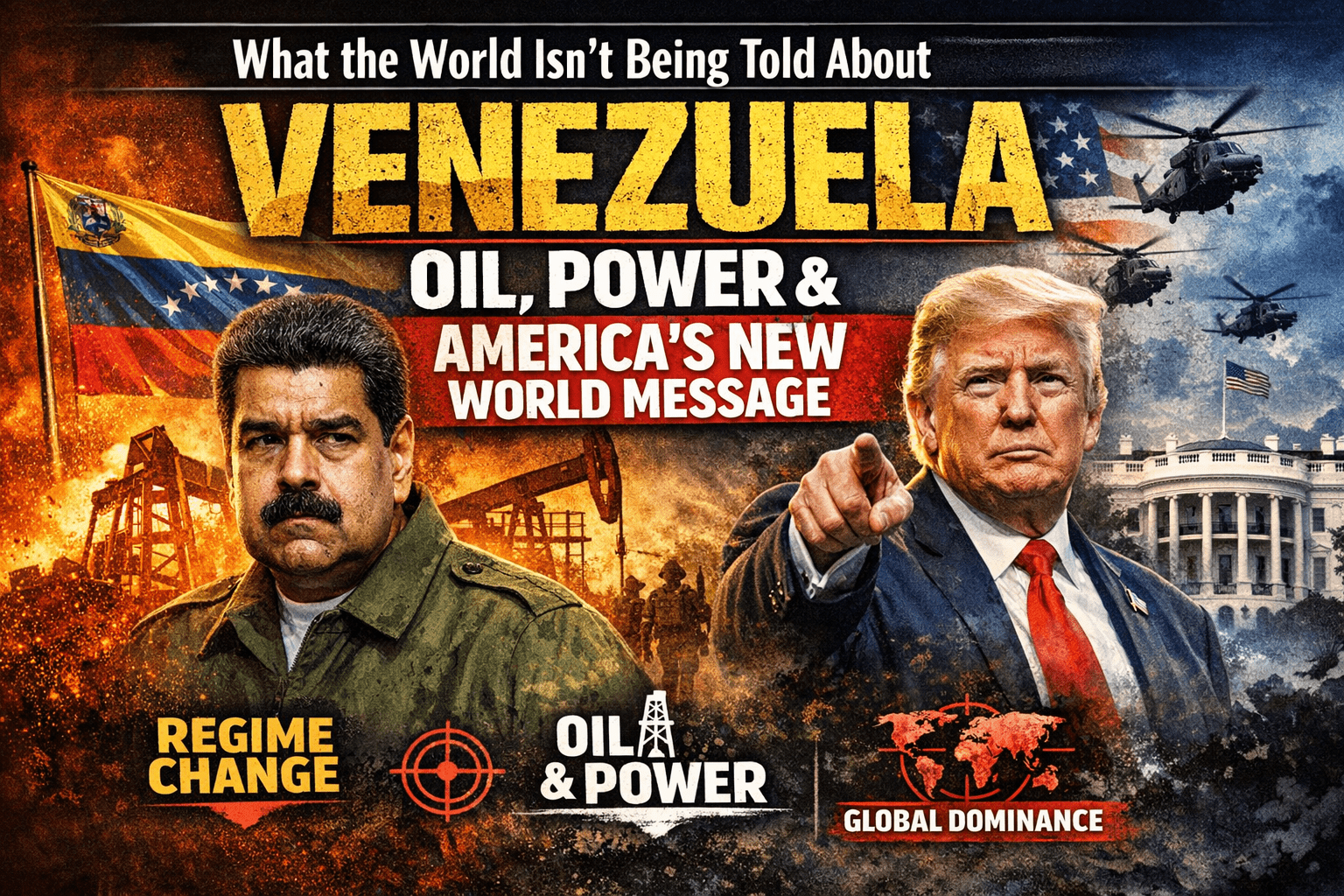
What the World Isn’t Being Told About Venezuela: Oil, Power, and America’s New World Message
The world woke up in shock this week to reports that the United States had captured Venezuelan President Nicolás Maduro and his wife in a high-risk military operation and transported them to U.S. soil. Within hours, headlines across the globe framed the story as part of America’s “war on drugs” or a decisive strike against narco-trafficking.
But that explanation barely scratches the surface.
What unfolded in Venezuela on January 3, 2026, was not a routine counter-narcotics operation, nor was it a sudden act of military adventurism. It was a carefully scripted geopolitical message—one aimed not just at Caracas, but at Beijing, Moscow, and the emerging idea of a multipolar world order.
To understand why Venezuela matters, and why this operation is far bigger than one arrest, we need to look beyond what is visible—and examine what is deliberately not being shown.
What Happened on January 3, 2026?
According to U.S. President Donald Trump, American forces carried out a large-scale military operation involving over 150 aircraft, coordinated intelligence inputs from the CIA, and months of surveillance on President Maduro’s movements.
U.S. officials claim:
-
Maduro’s daily routine was mapped in detail
-
Entry into the presidential compound occurred within a narrow time window
-
Heavy resistance was met with “overwhelming force”
-
All U.S. personnel returned safely
The operation was reportedly monitored live from the White House Situation Room.
Venezuela’s response was immediate and furious.
Caracas rejected the narrative of a lawful arrest, calling the act a “kidnapping” and a direct assault on national sovereignty. A state of emergency was declared, making it clear that this was not viewed as a law-enforcement action—but as an act of war.
And that raises the central question:
Why Venezuela? Why now?
This Is Not Just About Drugs
The U.S. justification rests on allegations of narcotics trafficking. But if this were purely about drugs, similar actions would have been taken against multiple regimes across Latin America and beyond.
They were not.
The scale, precision, and symbolism of this operation suggest something much larger:
a strategic reset of American dominance in its hemisphere.
Layer One: How Venezuela Went From Rich to Ruined
Venezuela is not a poor country by natural standards. In fact, it sits on the largest proven oil reserves on Earth.
-
303 billion barrels of oil (about 18% of global reserves)
-
Vast natural gas reserves
-
Hydropower supplying a major share of electricity
-
Significant deposits of iron ore, bauxite, and aluminum
At one point, Venezuela ranked among the wealthiest nations in Latin America.
So what went wrong?
The Oil Trap
In 1976, Venezuela nationalized its oil sector.
When Hugo Chávez came to power in 1999, oil revenues were redirected into massive welfare and subsidy programs.
Initially, it worked.
But over time:
-
The economy became completely oil-dependent
-
Industrial diversification collapsed
-
Technology investment stagnated
In 2007, Chávez pushed foreign oil companies out, handing control to state firms. American energy giants exited Venezuela—and relations with Washington deteriorated rapidly.
Dollar Pressure and Economic Collapse Venezuela
Venezuela’s pivot toward China and Russia, combined with its decision to trade oil in non-dollar currencies, struck at the heart of American power: the petrodollar system.
Washington responded with sanctions.
The result:
-
Banking systems frozen
-
Oil stuck underground but unsellable
-
Hyperinflation destroyed the currency
-
Over 7 million Venezuelans fled the country
Venezuela became a paradox:
one of the richest energy nations on Earth—with empty shelves and food lines.
Layer Two: America’s Strategic Motive
Donald Trump’s focus on Venezuela did not begin in 2026.
-
2019: The U.S. recognized opposition leader Juan Guaidó as president
-
Maduro was accused of narco-terrorism
-
Military action was openly discussed
When Trump returned to power in 2025, Venezuela re-emerged as a top foreign-policy priority.
Why?
Because in Washington’s view, America is back to enforcing its backyard doctrine.
The Double Standard Problem
The U.S. argues it cannot tolerate hostile powers near its borders.
But critics point out the contradiction:
-
Russia is condemned for opposing NATO near Ukraine
-
China is criticized for asserting regional dominance
-
Yet the U.S. claims absolute authority in Latin America
This is not new.
It is a revival of the Monroe Doctrine—an 1823 policy declaring that any foreign influence in the Americas would be treated as a threat.
Venezuela, with deep Chinese and Russian involvement, crossed that line.
Layer Three: Oil, China, and Global Power
This is where the story truly turns global.
Why Venezuela Matters to China
-
China’s CNPC is the largest foreign investor in Venezuela
-
Billions invested in the Orinoco Belt
-
New energy deals signed as recently as 2024
For Beijing, Venezuela is a pillar of long-term energy security.
Russia, too, is a major buyer of Venezuelan oil.
By removing Maduro and destabilizing Caracas:
-
China’s investments are placed at risk
-
Russia’s energy leverage weakens
-
U.S. influence over global oil prices strengthens
Control Venezuela—and you reshape energy geopolitics.
A Familiar Pattern
This is not the first time Washington has followed this script.
History offers striking parallels:
-
Saddam Hussein (Iraq, 2003): Weapons of mass destruction claimed—never found
-
Manuel Noriega (Panama, 1990): Captured and flown to the U.S.
-
Jean-Bertrand Aristide (Haiti, 2004): Forced into exile
The justification changes.
The outcome remains the same.
Where oil, currency power, and dominance are at stake, sovereignty becomes negotiable.
The Message to the World
The arrest of Maduro is not about Venezuela alone.
It is a message to:
-
China: Your energy corridors are vulnerable
-
Russia: Your allies are not safe
-
The Global South: Power still dictates rules
After years of talk about a multipolar world, Washington has signaled that the old order is not dead.
Global Reactions: Silence Speaks Loudest
While Russia condemned the action as aggression, global opposition has been muted.
Ukrainian President Volodymyr Zelensky suggested such actions prove that “dictators can be removed”—a statement widely interpreted as wishful thinking regarding Russia.
Few nations have openly challenged Washington.
That silence itself reflects the reality of global power.
What Comes Next?
The fallout will be far-reaching:
-
Venezuela’s alignment may shift permanently
-
China’s Latin American strategy faces disruption
-
Oil markets may see tighter U.S. influence
More importantly, the idea of a rapidly emerging multipolar world has suffered a serious setback.
Not a War on Drugs—A War on Influence
The capture of Nicolás Maduro is not a footnote in global news.
It is a defining moment in 21st-century geopolitics.
This was not about narcotics.
Not about democracy.
Not even about Venezuela alone.
It was about who writes the rules of the world—and who enforces them.
And for now, the United States has made one thing unmistakably clear:
The world may be changing—but power still speaks the loudest.
for more news